Who answers your customer: the AI, the person on duty, or you?
· 13 min read
Most small businesses have one tier of customer service, and it is the owner. Here is how to split the work into three, with a written line between them.
In most small businesses, customer service has exactly one tier, and it is the owner. The phone is in the founder’s pocket. The WhatsApp messages land on the founder’s personal number. Staff answer what they can and forward the rest “to oga” or “to the boss”. It works until the business grows past the point where one person can hold every conversation, and then it quietly stops working: replies get slower, promises get inconsistent, and the founder cannot take a week off without the business noticing.
The usual fix is to hire someone to answer the phone, or more recently to switch on an AI chatbot. Both help, but neither solves the real problem, which is that nobody has written down who is allowed to decide what. Without that line, a new receptionist and a new AI both end up doing one of two things: deciding things they should not, or passing everything back up to the owner.
This article sets out a simple model with three tiers: the AI receptionist, the person on duty, and you, the owner. It explains what each tier should do, what goes wrong when the tiers blur, and how to write the line between them so that it holds. It ends with a list you can work through this week, whether or not you use any software at all.
The three tiers
The figure below is the whole model on one page. Read it from left to right: each column is a tier, and each tier hands upwards only what it cannot settle itself.
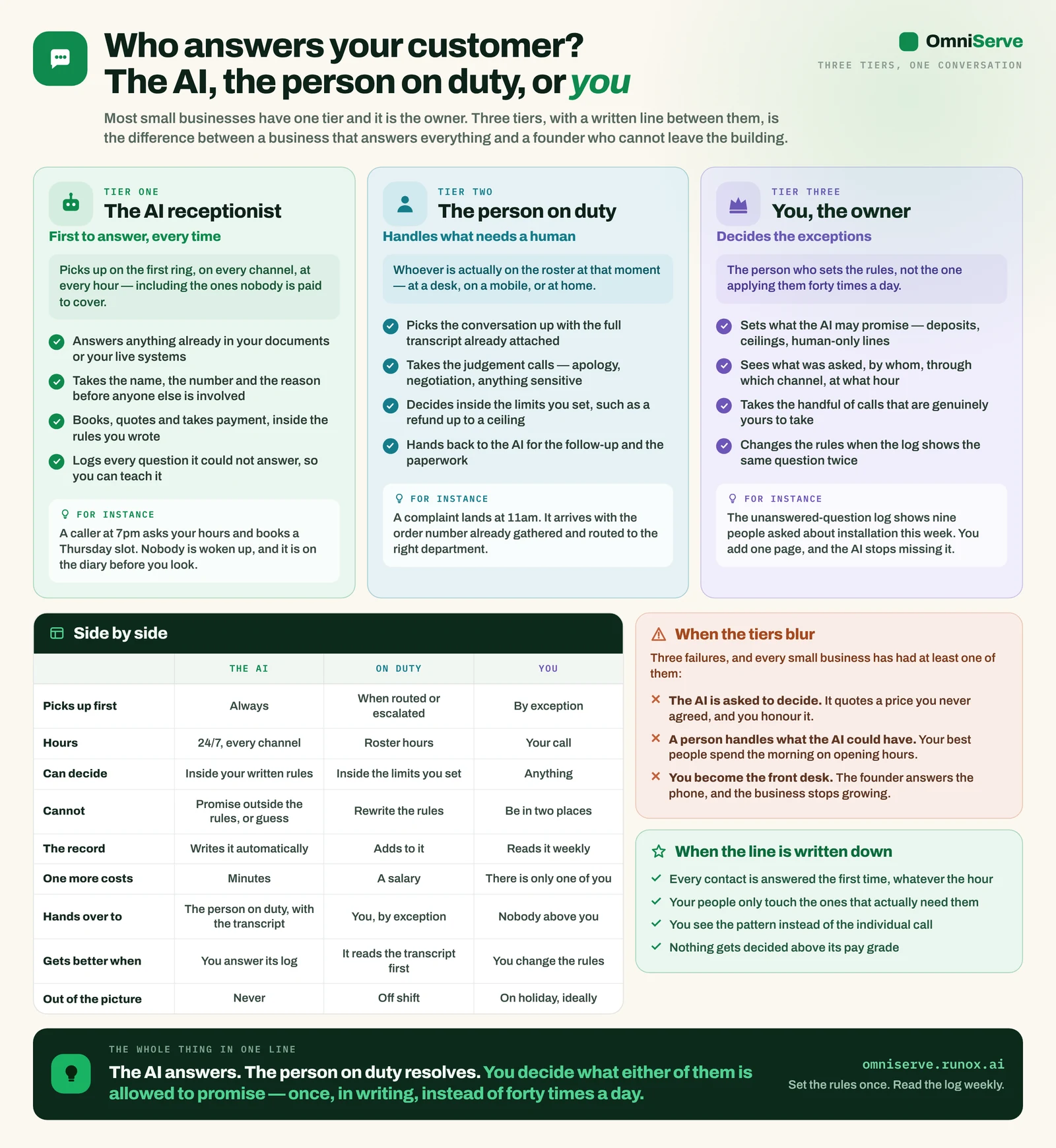 Figure 1: Three tiers, one conversation. Notice the “Can decide” row of the table: inside your written rules, inside the limits you set, and anything.
Tier one: the AI receptionist answers first
The first tier is the one that never sleeps and never has a busy afternoon. Its job is to pick up, find out who the customer is and what they want, and settle everything that can be settled from what you have already written down: opening hours, prices, delivery areas, how to book, what a product does.
Notice the verbs in the first column of the figure. The AI answers questions from your documents, takes the name, the number and the reason before anyone else is involved, books and quotes inside the rules you wrote, and logs every question it could not answer. That last one matters most, and we come back to it below.
The example in the figure is ordinary on purpose: a caller at 7pm asks your hours and books a Thursday slot. Nobody is woken up, and the booking is in the diary before you look. Most of the contact a small business receives is like this. It needs an accurate answer quickly, not a person.
Tier two: the person on duty handles what needs a human
The second tier is whoever is on the roster at that moment, at a desk, on a mobile or at home. The word that matters is “roster”. It is not “whoever happens to see the message first” and it is not “everyone at once”. It is a named person, for a named period.
This tier takes the judgement calls: an apology that needs to sound like it came from a person, a negotiation, a complaint, anything sensitive. It decides inside limits you set, for example a refund up to a ceiling. And it starts with the full transcript already attached, so the customer does not have to repeat the story. When the human part is done, the follow-up and the paperwork go back to the AI.
The example in the figure: a complaint lands at 11am and arrives with the order number already gathered and routed to the right department. The person on duty starts at the point of judgement, not at “can I take your name?”.
Tier three: you decide the exceptions
The third tier is you. The figure puts it precisely: you are the person who sets the rules, not the one applying them forty times a day.
Your job in this model is to decide what the other two tiers may promise (deposits, discount ceilings, which things only a human may agree), to read what was asked, by whom, through which channel and at what hour, to take the handful of calls that are genuinely yours, and to change the rules when the log shows the same question twice.
The example: the unanswered-question log shows nine people asked about installation this week. You add one page to what the AI knows, and the AI stops missing it. Ten minutes of your time removes nine interruptions a week for everyone else.
The side-by-side table
The comparison table in the lower half of Figure 1 is worth reading row by row, because each row is a decision you will otherwise make by accident.
- Picks up first. The AI always; the person on duty when routed or escalated; you by exception.
- Can decide. The AI inside your written rules; the person on duty inside the limits you set; you, anything.
- Cannot. The AI cannot promise outside the rules, or guess. The person on duty cannot rewrite the rules. You cannot be in two places.
- The record. The AI writes it automatically, the person on duty adds to it, and you read it weekly.
- One more costs. Minutes for the AI, a salary for a person. There is only one of you.
- Gets better when. The AI improves when you answer its log; the person on duty when they read the transcript first; the whole system when you change the rules.
The “one more costs” row is the economic argument in a single line. Adding capacity at tier one is cheap and immediate. Adding it at tier two is a hiring decision. Adding it at tier three is impossible. So the model works by pushing every conversation down to the cheapest tier that can settle it properly, and no lower.
What goes wrong when the tiers blur
The figure lists three failures, and almost every small business has had at least one of them.
The AI is asked to decide. It quotes a price you never agreed, and you honour it to keep the customer. This happens when the AI has been told what to do in a prompt but nothing actually stops it from doing otherwise. A determined customer can argue with a prompt. The fix is not a better prompt; it is a limit the system enforces before the answer goes out.
A person handles what the AI could have. Your best people spend the morning telling callers your opening hours and your delivery charge. This is the expensive failure, because it is invisible: everyone is busy, and the busyness looks like work.
You become the front desk. The founder answers the phone, and the business stops growing. Every question that cannot be answered by someone else ends up with you, so you are the bottleneck on every sale.
All three come from the same cause: no written line between the tiers. When the line is written down, the figure’s green box describes the result. Every contact is answered the first time, whatever the hour. Your people only touch the conversations that need them. You see the pattern instead of the individual call. Nothing gets decided above its pay grade.
Two puzzles
We use two short puzzles with business owners to make the cost of blurred tiers concrete. Both are hypothetical: the names, businesses and times are invented for illustration.
Which call cost the business most?
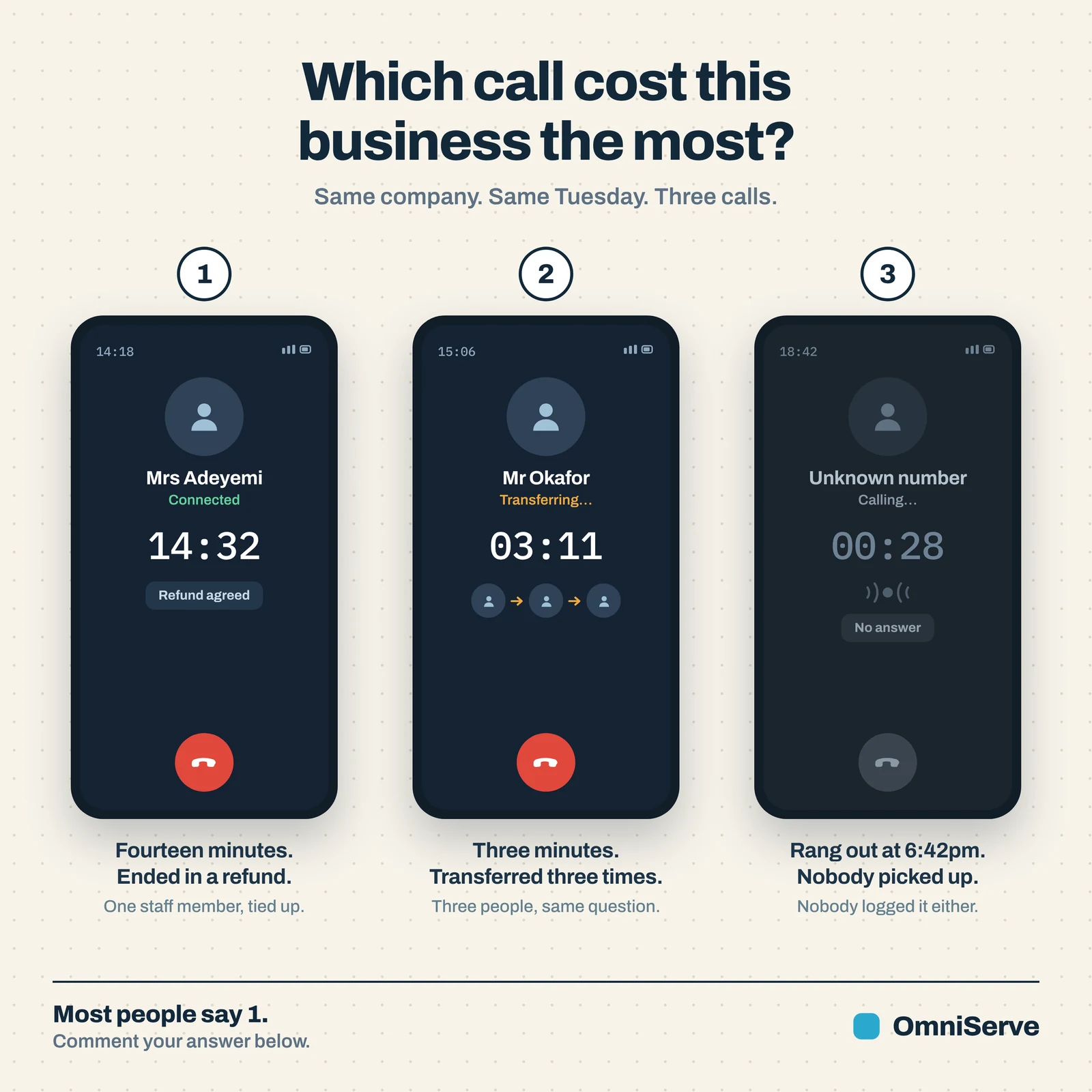 Figure 2: A hypothetical puzzle. Three calls, same company, same day. The image’s own prompt is “Most people say 1.”
The first call is fourteen minutes long and ends in a refund. It looks expensive: a staff member tied up and money going out. The second is three minutes long but transferred three times, so three people heard the same question. The third rang out at 6:42pm. Nobody picked up and nobody logged it.
The first call is the one people notice, because it has a visible cost. But a refund call is a customer being kept. The second call is a routing failure: it had no clear owner, so it bounced. The third is the costly one in most businesses, because it is invisible. You do not know who rang, what they wanted, or whether they went to a competitor. You cannot call back a number you never recorded.
In the three-tier model, call three is answered by tier one, whatever the hour. Call two goes to the right department at the first attempt, because the AI has already gathered the reason. Call one still happens, but the person on duty starts it with the transcript, and the refund sits inside a ceiling you set in advance.
Which business loses the customer?
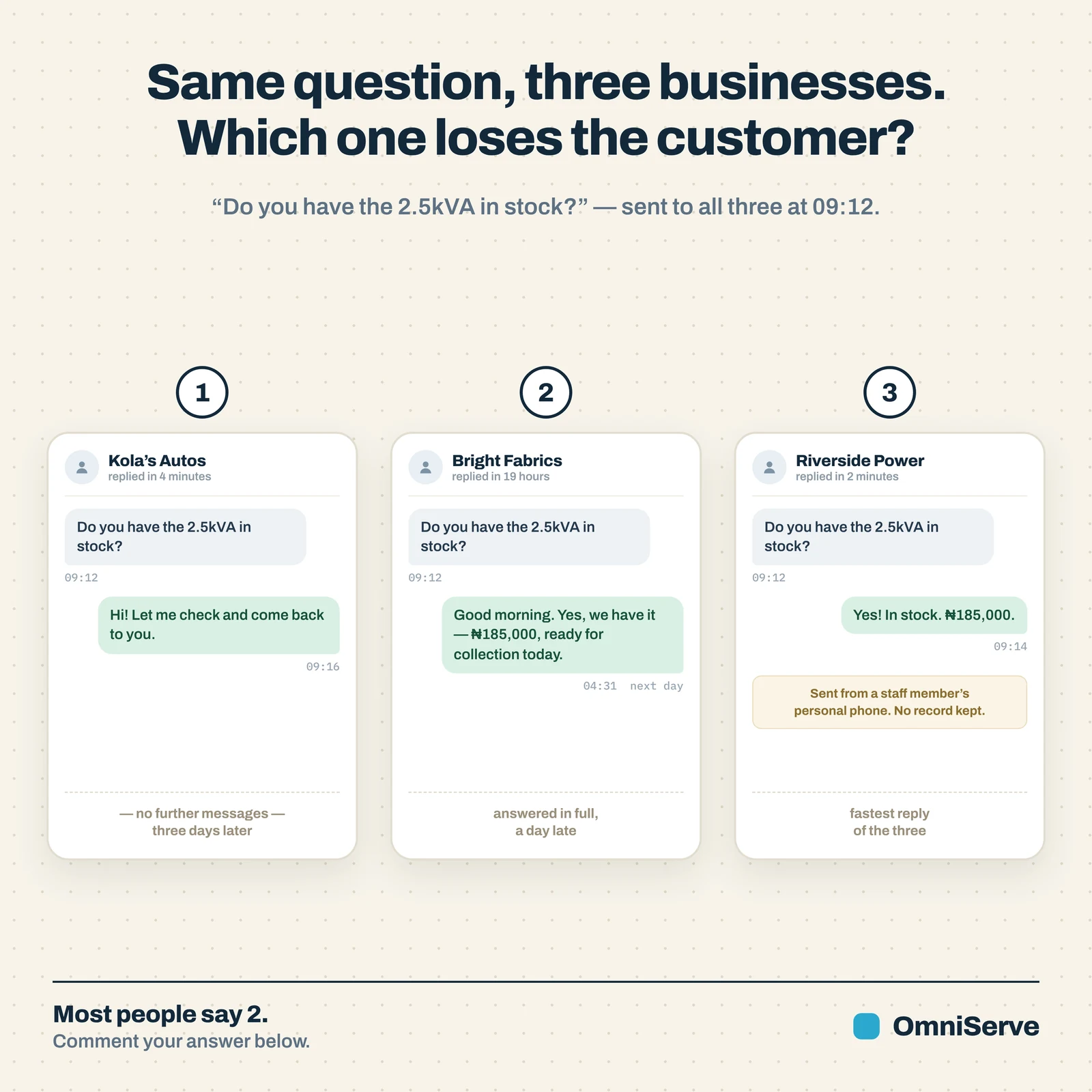 Figure 3: A second hypothetical puzzle. The same question sent to three businesses at 09:12. The image’s own prompt is “Most people say 2.”
The same question goes to three businesses at 09:12: “Do you have the 2.5kVA in stock?” The first replies in four minutes (“let me check and come back to you”) and then says nothing for three days. The second answers in full, with price and collection, nineteen hours later. The third replies in two minutes with the price, from a staff member’s personal phone, with no record kept.
The second business looks like the obvious loser because it is slowest. But the first business has made a promise and broken it, which is worse than being slow. And the third business has the best reply but has lost something else: the conversation lives on an employee’s phone. If that person leaves, is on leave, or simply forgets, the customer’s history goes with them, and the business cannot follow up, check what was quoted, or settle a dispute.
Each answer is defensible. That is the point of the puzzle. Every one of these failures is a tier failure: a first-tier promise with no follow-through, a first-tier question left waiting for a person, and a second-tier answer given outside the business’s own record.
Rules the platform enforces, not instructions in a prompt
If you take one technical idea from this article, take this one. There is a difference between telling an AI what it may do and making it impossible for it to do anything else.
An instruction in a prompt (“never offer more than 10% off”) is advice to the model. Most of the time it is followed. But a prompt can be argued with, and a customer who pushes hard enough, or phrases the request cleverly enough, can sometimes get past it. A rule enforced by the platform sits outside the conversation: the limit is checked before a price is ever quoted, so the model cannot be talked across it.
OmniServe takes the second approach for money. Deposit floors, discount ceilings and which products can be sold without a person are enforced by the platform before a price is quoted. The same applies to how the AI introduces itself: you can change the wording, but you cannot make it claim to be a person.
When you evaluate any AI receptionist, ask this question directly: if a customer insists, what physically stops your AI from offering a bigger discount? If the answer is “we tell it not to”, that is a prompt, not a rule.
Roster, departments and next-in-turn
Tier two only works if the system knows who is on duty. In practice that means three pieces of information.
Members, roles and departments. Who works here, what they are allowed to see and do, and which department they belong to (sales, support, accounts, deliveries). A complaint about an invoice should reach accounts, not whoever is nearest.
On duty. Who is actually available now. Someone who is off shift should not receive conversations, however good they are at handling them.
Next in turn. When several people in a department are on duty, conversations are shared out in turn rather than all landing on the fastest responder. Without this, your most conscientious person ends up doing most of the work.
In OmniServe, members, roles and departments, on-duty status, next-in-turn assignment, and which channels each person answers are all live as at October 2026. You also choose, per call link, whether the AI or a person answers first. If a person answers first, how long the call rings before the AI picks up instead is configurable.
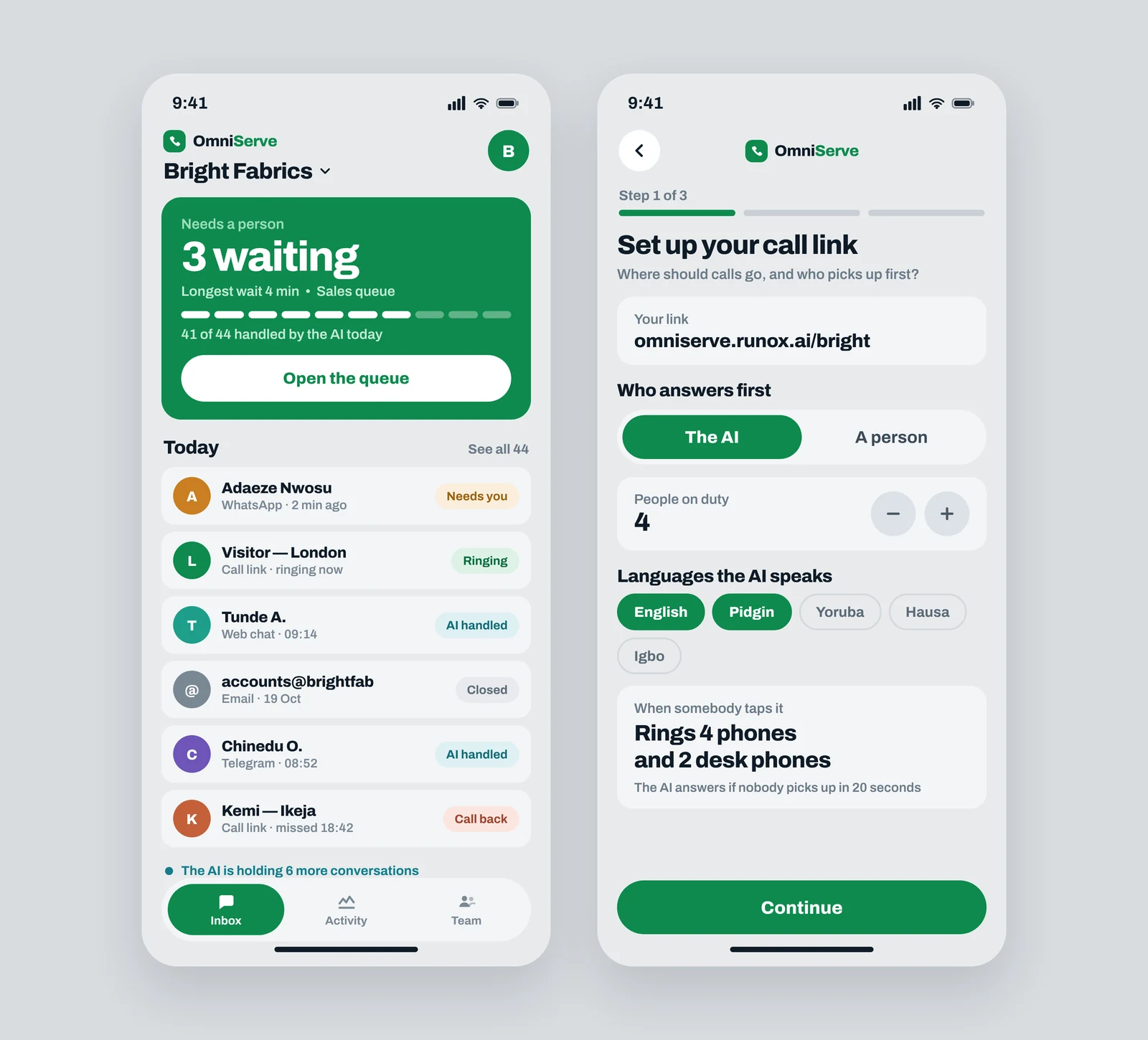 Figure 4: The phone app. On the left, the inbox sorted by who needs a person; on the right, the call link set-up, where you choose who answers first. The figures on both screens are examples.
What to notice on the left-hand screen is the sorting. The top card is not “all messages”; it is “needs a person”. Conversations the AI has settled are marked “AI handled” and stay out of the way. The person on duty sees only what is theirs, plus a “Call back” flag for a call that was missed. The numbers on the screen (“3 waiting”, “41 of 44 handled by the AI today”) are illustrative.
On the right, the set-up screen asks the question this whole article is about: who answers first? Two caveats on that screen as at October 2026. The language chips for Pidgin, Yoruba, Igbo and Hausa show features that are built and in testing; the AI answers in English today. And ringing several phones at once is also in testing, so treat “Rings 4 phones and 2 desk phones” as where the product is heading. The 20 seconds shown is an example setting, not a fixed value. Queues, where callers wait for the next free person, are in testing too.
A worked example (hypothetical)
Here is how the three tiers might look for a small business. The company is invented.
A generator and solar supplier in Lagos has six staff: the owner, two in sales, one in accounts, and two technicians who do installations. Before, every enquiry went to the owner’s WhatsApp, and sales staff forwarded anything awkward to the owner.
Tier one. The AI is given the price list, the delivery areas and charges, warranty terms and the installation booking calendar. It answers stock and price questions, books site surveys into the technicians’ calendar, and takes name, number, product and location for anything else. It has a written rule: no discounts at all, and a deposit is required for any installation booking.
Tier two. Sales staff are on duty in shifts from 8am to 6pm, Monday to Saturday, and receive conversations in turn. They can offer up to 5% off on orders above a set value. Accounts handles any question about an invoice or a payment. Each person sees the transcript before replying.
Tier three. The owner takes bulk orders above a threshold and any complaint involving a safety issue. Every Friday, they spend twenty minutes reading the unanswered-question log and the list of conversations passed to a person, and add one or two pages to what the AI knows.
After a few weeks, the log tells the owner something they did not know: the most common unanswered question is about financing, not stock. That is a business decision, not a customer service one, and the owner only sees it because the record exists.
Do this this week
You can start on this model without buying anything.
- List your last 50 customer contacts. Calls, messages and emails. Mark each one: could it have been settled from information you already have written down? You will probably find most of them could.
- Write the tier-one rules. One page: what may be answered without a person, what may be booked, what may be quoted, and what must never be promised.
- Write the tier-two limits. For each person who answers customers: what they may decide alone (a refund ceiling, a discount ceiling, a delivery waiver) and what must come to you.
- Write your own list. The few things only you will decide. Keep it short. If it is long, the line is in the wrong place.
- Draw up a roster. Who is on duty, when, and for which channels. Include evenings and weekends, even if the answer is “nobody”, so you know where the gaps are.
- Move conversations off personal phones. Business conversations should live in a business record, not on an employee’s handset.
- Book twenty minutes a week. Read the questions nobody could answer, and fix the most common one.
Where OmniServe fits
OmniServe is built around this three-tier model. The AI receptionist answers first on calls and chat, taught from your website and documents, and logs every question it could not answer. Handover rules decide when a person takes over, and the person on duty receives the conversation with its transcript, assigned in turn within the right department. Money limits are enforced by the platform rather than written into a prompt, and the inbox is sorted by who needs a person.
Live as at October 2026: the AI receptionist on calls and chat, handover rules, the inbox sorted by who needs a person, members, roles, departments, on-duty and next-in-turn assignment, and the report of questions the AI could not answer. In testing: queues and the call menu, ringing several phones at once, and the four Nigerian languages. Our status page lists both, because you will find out anyway.
Answer every customer, on every channel. See how OmniServe runs your front desk: omniserve.runox.ai
Sources
- OmniServe, “Questions: the things people ask before they buy”, October 2026. https://omniserve.runox.ai/site/faq
- OmniServe, “What’s running today, and what isn’t yet”, October 2026. https://omniserve.runox.ai/site/status